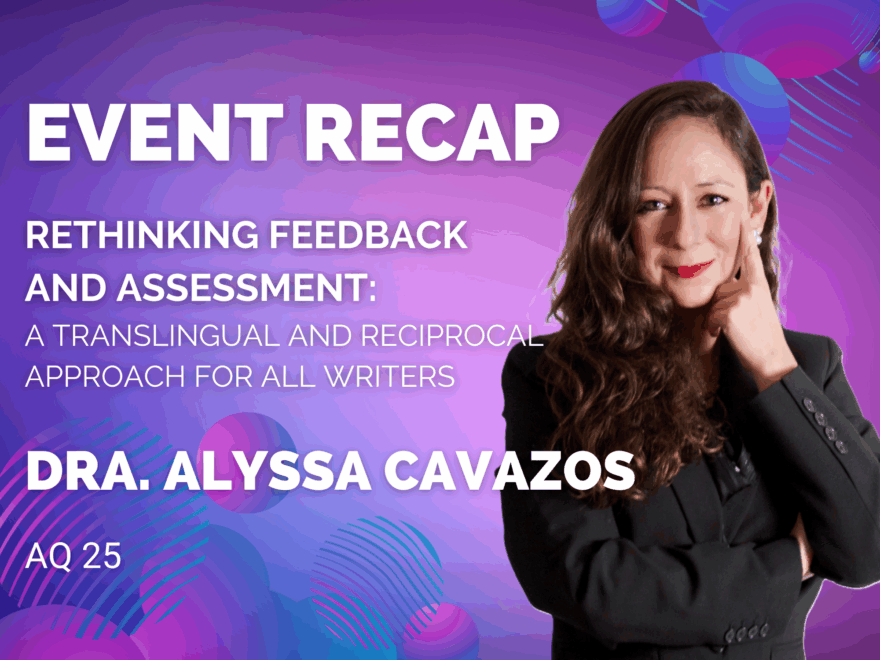
On Wednesday, October 29th, 2025, Dra. Alyssa Cavazos held a workshop on feedback strategies for student writing, focusing on how a broader view of approaches to feedback and assessment can be used to encourage student success.
To start off the workshop, WRD’s Dr. Monica Reyes introduced Dra. Cavazos. She is a professor of writing and language studies at the University of Texas Rio Grande, and is the director of the university’s Center for Teaching Excellence. Much of her work is focused on learner-centered pedagogies that incorporate translingual approaches and support linguistic variation.
The workshop was held over Zoom, with some attendees joining virtually, and some in person at SAC 301. The event began with attendees sharing feedback strategies that they already find helpful or meaningful, as well as challenges they frequently encounter.
Key Concepts
Next, Dra. Cavazos defined a number of concepts in the field of rhetoric and composition studies that are helpful to consider when giving feedback that learners can use to grow. These include:
- Translanguaging pedagogy: Largely popularized by scholars Garcia and Wei, this is pedagogy that allows students to exercise creativity by moving beyond the boundaries of a single language or medium.
- Critical language awareness: This encourages people to be aware of power structures and standardization. Students already navigate between different language communities, so by giving them critical awareness of the practices they already use, they can intentionally cross boundaries to better connect with their audience, leveraging all the language and non-language tools they have available.
- Feedback literacy: Dra. Cavazos emphasized how important it is for students to be able to have agency over their own writing, ask for the type of feedback that’s most helpful for them, and use that feedback. Eventually, this awareness will enable students to give meaningful feedback to peers as well.
- Communal justicing: This is when people come together and revise policies that enforce disciplinary assessment structures. By coming together and intervening in narratives that enforce black-and-white methods of assessment, they can promote equity in education.
The attendees came together to discuss these concepts, highlighting what resonated with them, what they already utilized in their teaching work, and what they found challenging to implement.
Strategies
Dra. Cavazos outlined several strategies professors can use when giving feedback that follows these ideals. Some are her own, and some draw on existing literature from other scholars in the field. For each of these, she provided examples of her own feedback to students where she had utilized these ideas or encouraged her students to use them.
- Intentionality and transparency: When professors are clear about what they want, what their purpose is in giving feedback, and what they expect students to do, students don’t have to guess. Acknowledging that academic expectations depend on the context and field and staying open to negotiation leaves room for the writer’s intentions, goals, and voice to flourish.
- Conversational and collaborative: By showing interest in students’ ideas and goals, and by referencing the language they use, professors can encourage students to think, explain, and enter the dialogue. Professors can also utilize peer feedback to encourage students to communicate with and build each other up.
- Reflective and reflexive: It’s important for educators to consider assumptions that are being made, both on their part and on the part of the writer. Asking questions can help challenge these assumptions and figure out why a writer might be making certain decisions, whether it has to do with their cultural background, or what they think they’re allowed to do.
- Feedforward: Rather than feedback, which often focuses on what a writer should have done, feedforward encourages students to look at their work with future revisions or upcoming assignments in mind.
Once again, attendees paused for discussion, sharing specific ways they had in the past or looked forward to implementing these strategies. Some ideas that came up during this discussion were:
- Using audio feedback (with transcripts) for a more conversational tone, which can be difficult to achieve over online or asynchronous modalities
- Asking students to provide a writer’s memo with drafts (giving them an opportunity to contextualize their work), and giving them an opportunity to respond to the first round of feedback
- Making space in class for conversations and feedback between students to supplement instructor feedback, since professors are often short on time and space
Key Takeaway
In this workshop, Dra. Cavazos provided many valuable insights on how translingual and reciprocal approaches to feedback can put students on the path to success. It also provided a space for attendees to reflect on and share their own feedback practices, building on each other’s knowledge and asking questions.
To learn more about other upcoming and past events hosted by the WRD department, check out the Department News & Events page on the WRD Blog.