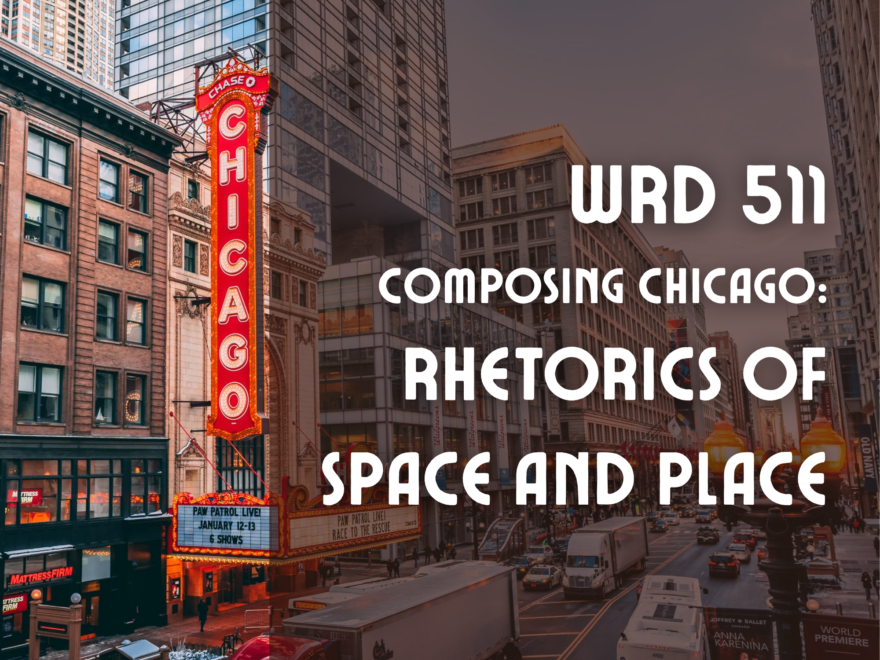
The rhetoric of place allows us to explore how the physical environment itself makes arguments. What better way to examine it than through the very city we live in? This winter, students can see how discourses, social actions, and more build the environment around us in WRD 511, Composing Chicago: Rhetorics of Space and Place, taught by Professor Jason Kalin.
Why this topic?
“My teaching and research interests continually return to questions of place, especially this place we call Chicago,” Kalin says. It’s a topic that he’s been studying throughout his academic career. “I began studying rhetorics of space and place during my graduate work in Communication, Rhetoric, & Digital Media at North Carolina State University. I became interested in memory—one of the five canons of rhetoric—and how memory is tied to places as in the classic mnemonic technique of building memory palaces and as with monuments, memorials, and public art. My colleague Dr. Jordan Frith and I applied the concept of memory palaces to better understand practices of ‘placed-based digital memory.’ This article was also influenced by Michel de Certeau’s The Practice of Everyday Life, especially the influential chapter, ‘Walking in the City,’ in which he argues for a ‘rhetoric of walking.’”
Place, memory, walking, and the city of Chicago are themes that Kalin often teaches at DePaul. “In many of my courses, I ask students to study their own involvements with the city, such as WRD 283: Environmental Writing wherein students study the ‘nature’ in their dooryards.” Kalin also teaches LSP 110, Walking Chicago: A History in Footsteps, “which uses Chicago as our classroom and encourages students to become walkers, flâneurs, and psychogeographers of the city’s varied ambiances to walk, write, and weave themselves into the city.”
Modality
This course is in the flex modality: students may choose to attend each class session either in person or via Zoom, based on their needs and availability throughout the quarter.
Assignments and readings
WRD 511 is a topics course. Although Kalin is no stranger to the subject, this course is new, so the details are still being refined, and some of the major assignments are still subject to change.
“One project might ask students to examine urban planning documents for an ‘empty lot’—a contested or transitional urban space,” Kalin explains. “This textual and visual analysis might be combined with rhetorical ethnography—in a limited way—by going to a community meeting where the future of this ‘empty lot’ is being discussed, or by walking to the place of inquiry to observe and document vernacular claims on this place. A corresponding project might use the ArcGIS StoryMaps platform to create an interactive digital map, layering institutional rhetorics against vernacular rhetorics to trace competing spatial arguments. In this way, students examine how Chicago’s future is being constructed, by whom and for whom.”
He continues, “Given my interest in walking in the city, another project might incorporate techniques of walking, or walking methodologies, such as the Situationist dérive to collect found objects and material debris, ambient audio recordings, and photographs to create an (an)archival exhibition to reveal the city’s minor gestures and vernacular rhetorics.”
Students will also get the opportunity to do plenty of reading to become familiar with and situate themselves in these perspectives. Kalin provides a tentative list for course readings below:
- City of Rhetoric: Revitalizing the Public Sphere in Metropolitan America. David Fleming examines the spatial segregation of Chicago, focusing on Cabrini-Green’s (re)development, to show how urban policy and architecture construct and restrict publics.
- Angels’ Town: Chero Ways, Gang Life, and the Rhetorics of Everyday. Ralph Cintron studies the Mexican-American community in Chicago to show how they struggle for and (re)claim respect through vernacular rhetorics and everyday tactics.
- Democracy’s Lot: Rhetoric, Publics, and the Places of Invention. Candice Rai investigates how an “empty lot” in Uptown becomes a wellspring of democracy in action. We may also read chapters from Rai & Caroline Gottschalk’s Field Rhetoric: Ethnography, Ecology, and Engagement in the Places of Persuasion.
- Maxwell Street: Writing and Thinking Place. Tim Cresswell, a cultural geographer, approaches Maxwell Street as an assemblage of things, meanings, and practices, thus offering another model for thinking and writing about place.
Registration is open! If you’re interested in gaining a rhetorical perspective on the space around us, head to CampusConnect and register for WRD 511 today.