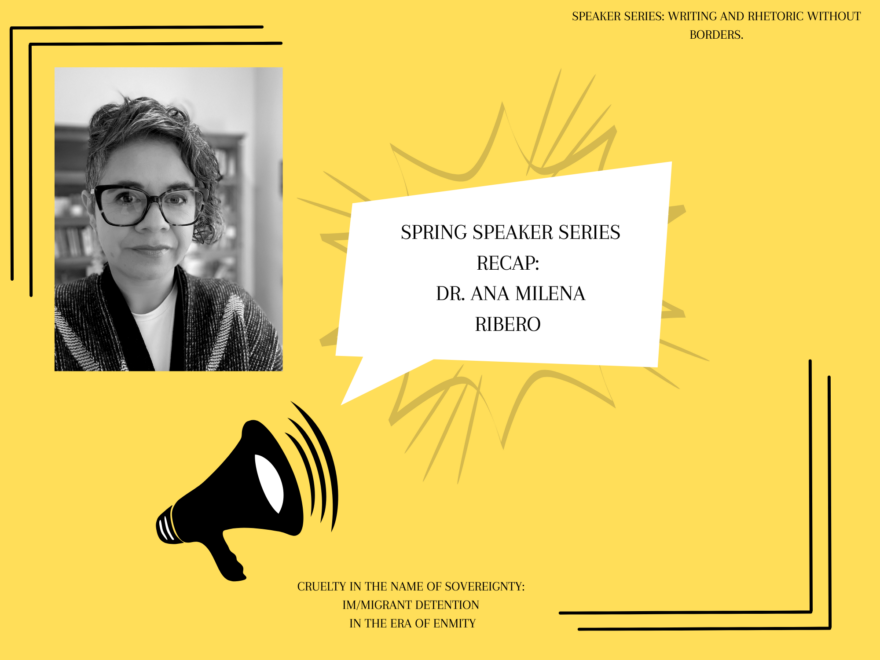
In April, The WRD Department welcomed Dr. Ana Milena Ribero for our Speaker Series: Writing and Rhetoric without Borders. Dr. Ribero is a MAWRD alum and an Associate Professor of Rhetoric and Composition at Oregon State University. Her research has been on immigration for the last 15 years, which led her to focus on cruelty and lack of care in immigrant detention centers. Her talk, “Cruelty in the Name of Sovereignty: Im/migrant Detention in the Era of Enmity”, explored the use of solitary confinement and isolation as a means to communicate power and cruelty as deliberate rather than a failure of care. To an audience of faculty and students attending in person and via Zoom, Dr. Ribero’s central claim was that the United States has cruelty baked into its foundational ethos.
She posited, “This nation was created against a common enemy, the Indigenous peoples of Turtle Island, the British Empire, the Southern Confederacy, or if you were south of the Mason-Dixon line, the Union, and much later, of course, the communist threat to the East. In our era of globalization, the many enemies of the state are diffused throughout the world.”
Dr. Ribero’s 2023 book, Dreamer Nation: Immigration, Activism, and Neoliberalism (Rhetoric, Culture, and Social Critique), only touched on immigration detention in one chapter. In an interview before her talk she told me, “I started looking at that [immigration detention] and writing about it, and I presented on it at C’s last year [Conference on College Composition and Communication]. It felt like there was a purposeful lack of care, and the idea that it was intentional started coming up for me as I read more reports and more firsthand accounts.”
Her talk provided historical context of the United States and points to three intersectional uses of immigrant detention that allow it to serve its political and rhetorical purpose:
- Regime of Deportation
- Theater of Power
- Prevention through Deterrence
Dr. Ribero continued, “Immigrant detention must be witnessed, and its rhetorical effectiveness can be measured by the numbers. The more people being detained, the stronger the state’s demonstration of power. But detention is never only about warm bodies in detention centers. For it to serve its third rhetorical purpose, it must, I argue, also be supremely cruel.”
Through firsthand accounts and extensive reporting, Dr. Ribero pointed to United States’ immigrant detention practices “as a form of biopolitics that reaffirms the nation-state’s right to inflict suffering.” The dehumanization of Chinese Immigrants after the Page Act of 1875 and Chinese Exclusion Act of 1882 and Mexican Immigrants through the 1926-1936 Repatriation are just a few historical examples provided in order to understand the United States’ treatment of Otherness. Dr. Ribero also quoted individuals who were cited in a 2023 complaint against ICE and its use of solitary confinement.
Dr. Ribero concluded her talk with a Q&A, speaking on her role as educator and advocate. While there are limits to research and its direct effectiveness, she recognizes the power of ideas and bringing meaningful rhetorical conversations to students. As we concluded our interview, she noted that her next book will be a more accessible version of this important work to bring to students and their communities.
“I do think that there’s really important conversations to have beyond academia… Having conversations with them [students] and passing on that knowledge and hoping that they will then have a conversation with their parents or friends or roommates, that’s how I see the work that we do as academics as having an impact. It’s those ways that we spread the knowledge that we have with students, and then they hopefully go out and spread it to the rest of the community.”
Visit the Student and Alumni News page to read about other outstanding work done by WRD alumni and students.